Pulse 08 · September 3, 2026 · 6 min
Watching Emily Ross
Emily Ross carries no tablet, wears no headset and rarely speaks. So why does Coach Ethan Harper keep looking her way?
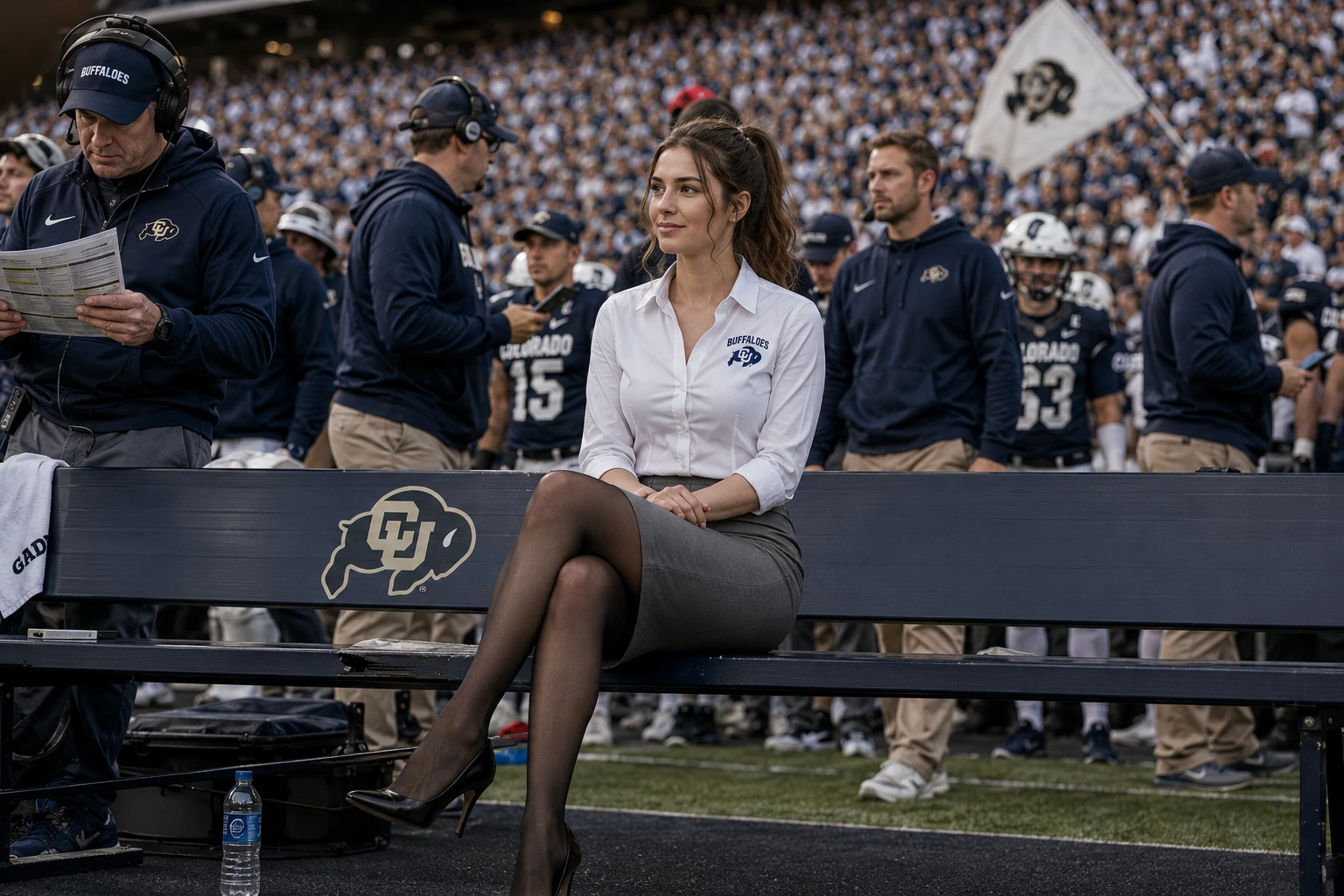
There are only so many ways to write about college football.
By the middle of every season, even the most dramatic Saturdays begin to borrow from one another. A quarterback forces a throw into double coverage. A defensive back celebrates an interception as though he planned it all along. Coaches remind reporters that football is a game of execution, while players promise to correct mistakes that will almost certainly be replaced by different ones seven days later.
After a while, the game itself stops surprising you.
Saturday's win over Western State was one of those afternoons. The Buffaloes controlled the game without ever quite dominating it. The offense moved efficiently between the twenties before stalling in predictable places. The defense allowed enough yardage to keep everyone honest without ever seriously threatening the result. By the beginning of the fourth quarter I already knew how my game report would read.
That is usually when I begin watching everything except the football.
A college football sideline is an interesting place if you stop looking for the ball. Position coaches never seem to stand still for more than a few seconds. Graduate assistants carry tablets from one end of the bench to the other as though every possession depends on arriving five seconds sooner. Equipment managers somehow appear exactly where they're needed before anyone asks. Conversations overlap constantly. Someone is always chewing gum. Someone is always talking through a headset.
Everyone appears busy.
Except Emily Ross.
I finally learned her name during the second week of the season. Learning what she does has proved considerably more difficult.
She remains the only woman on the Buffaloes' bench, surrounded almost entirely by former players and assistant coaches dressed in navy hoodies, baseball caps and headsets. Emily looks as though she has accidentally wandered into the wrong profession. Her white Buffaloes blouse is always neatly pressed, tucked into the same grey pencil skirt. Black stockings and polished heels complete an outfit that would attract little attention almost anywhere else but somehow stands out immediately on a football sideline.
The contrast, however, isn't what caught my attention.
It was what happened after I stopped looking at her appearance and started watching her behaviour.
Or perhaps more accurately, the lack of it.
She carries no tablet. I've never seen her write in a notebook. She doesn't wear a headset or speak into a microphone. During television timeouts she doesn't gather with the other assistants. Players don't line up to ask her questions. Position coaches don't seek her opinion between possessions. There is remarkably little to suggest she performs any role that would be familiar to someone who has spent years covering college football.
And yet, every Saturday, there she is.
For most of the second half I watched only Emily.
She rarely followed the football itself. Instead her attention drifted quietly across the sideline. Sometimes she watched players returning from the field. Sometimes she watched Coach Ethan Harper. Sometimes she seemed content simply to observe the movement around her without focusing on anyone in particular.
Then there were moments that puzzled me even more.
Several times she appeared almost... elsewhere.
Her eyes rested on the grass a few yards in front of the bench, not in the absent-minded way someone loses concentration, but with the calm expression of a person quietly occupied by thoughts nobody else could see. Around her, assistant coaches argued over personnel groupings and substitutions while graduate assistants hurried back and forth carrying fresh photographs from the press box.
Emily never seemed hurried.
She simply sat.
After a minute or two she would lift her eyes again, glance briefly towards the field, then towards Coach Harper before returning to the same quiet stillness.
It happened often enough that I found myself checking whether I'd missed something.
I hadn't.
If anything, the more carefully I watched, the less I understood.
Every football program has people whose jobs aren't immediately obvious. Nutritionists, academic advisors, sports psychologists, recruiting analysts and administrators all move through a modern athletic department without necessarily drawing attention to themselves. Saturdays, however, have a way of making everyone's purpose visible. Even if you don't know someone's title, you can usually infer their responsibilities simply by watching them work.
Emily resisted that simple exercise.
She didn't look like an analyst studying tendencies.
She didn't look like a psychologist observing behaviour.
She didn't look like an administrator checking schedules.
She looked entirely comfortable occupying a place where nobody else seemed to have any obvious reason to sit.
Curiously, nobody around her behaved as though there was anything unusual about it.
The assistant coaches scarcely acknowledged her. Players came and went without stopping to talk. Equipment staff walked past carrying helmets and water bottles. Emily neither joined the conversations nor appeared excluded from them. She simply existed as part of the sideline's landscape, as familiar to everyone else as the benches themselves.
Coach Harper was the exception.
Every so often, perhaps three or four times during the afternoon, he looked in her direction.
Not dramatically.
Not searching for approval.
Just a brief glance.
Occasionally Emily answered with the smallest smile, almost apologetic in its modesty. Once she gave a slight nod before looking back towards the field. Nothing about those exchanges suggested urgency. If television cameras noticed them, they certainly didn't linger.
Neither did I.
At least, not yet.
There is a temptation in this profession to mistake unusual for important. Years of covering sport have taught me to resist that instinct. Sometimes an interesting observation remains nothing more than an interesting observation.
Still, football has also taught me something else.
When a coach as experienced as Ethan Harper repeats a habit often enough, it usually exists for a reason, even if that reason isn't immediately apparent.
I've submitted four interview requests with the athletic department since the season began.
Each has been politely declined.
The explanations have been equally polite and equally uninformative.
Perhaps one day they'll say yes.
Perhaps they'll continue saying no.
Either way, I'll probably keep asking.
Not because I think Emily Ross is secretly running the Buffaloes' offense.
Not because I believe I've stumbled across some hidden football revolution.
Simply because, after spending fifteen years around college football, she's the only person I've encountered whose role becomes less obvious the longer I watch.
And that's a rarity worth paying attention to.


Community notes
Join the conversation
Thoughtful contributions help keep Silverdale’s community conversations useful, welcoming and connected.
GRACE COMMUNITY
Thank you.
Your Community Profile could not be verified.
Comments become available after participation has been confirmed.