Pulse 08 · October 17, 2026 · 7 min
The wrong time to look away
A late Buffaloes loss left one unanswerable question on the sideline: why did Coach Harper keep turning to Emily Ross?
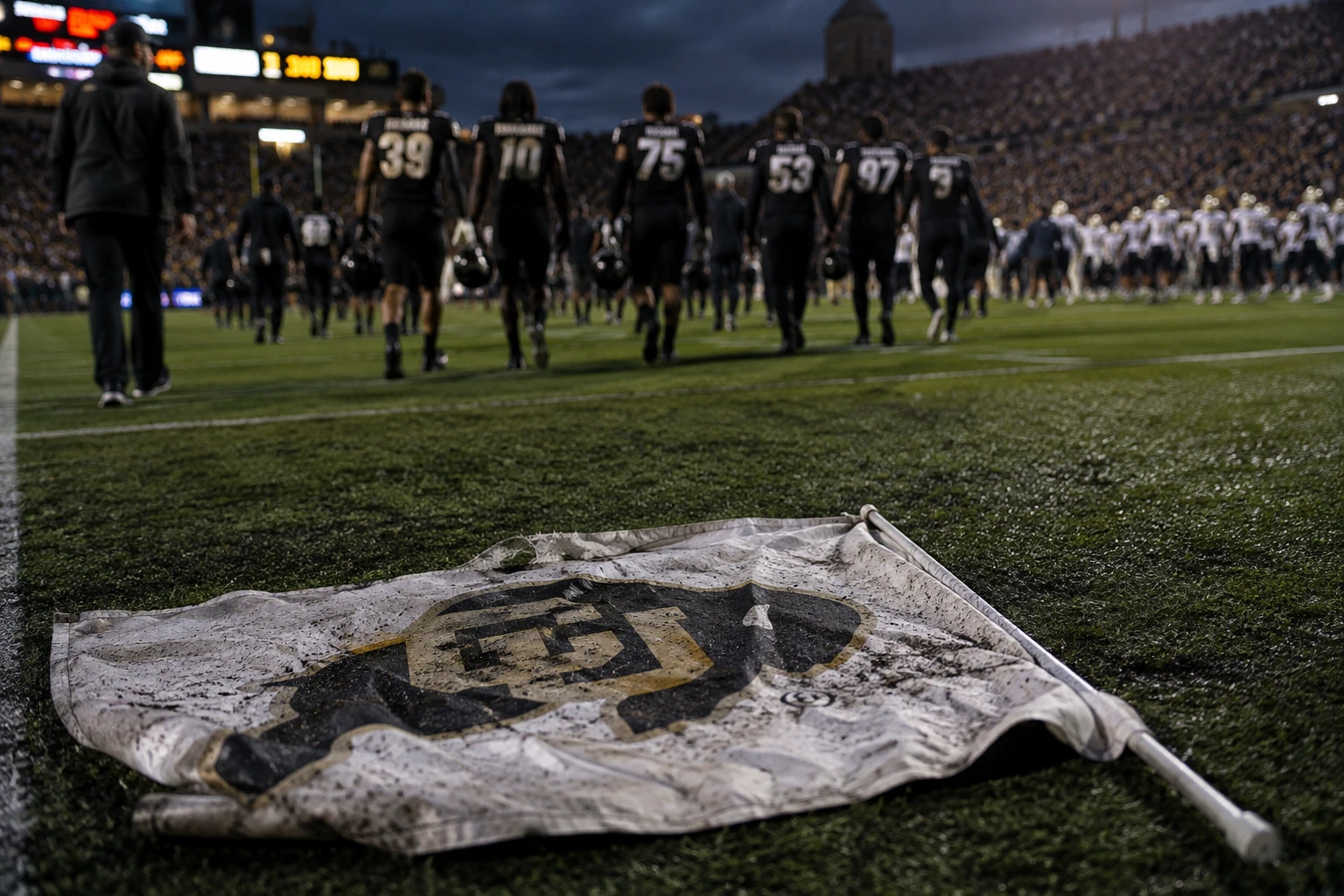
Every coach has a sideline version that rarely makes it onto television.
The broadcast catches the celebrations, the arguments with officials and the occasional headset thrown onto the turf. What it misses are the quieter moments between plays, when a game begins slipping away and everyone on the sideline starts searching for something they can’t quite name.
The Buffaloes spent most of Saturday afternoon chasing North Ridge University without ever catching them.
Nothing came easily. Third downs stalled. The running game disappeared before halftime. A veteran secondary, normally one of the calmest units in the conference, suddenly looked hesitant. By the middle of the fourth quarter the crowd had become restless, not because the Buffaloes were losing, but because they were running out of time.
Coach Ethan Harper looked every bit like a man who knew it.
He stopped pacing only because there was nowhere left to pace. His headset came off twice before finding its way back over his cap. One assistant followed him with a laminated play sheet, another with statistics printed moments earlier from the booth. Conversations started before being interrupted by another play. Nothing seemed to settle for more than a few seconds.
Emily Ross never moved.
She occupied the same folding chair she had occupied since kickoff, hands resting quietly in her lap. At one point she seemed to be studying a loose thread near the cuff of her blouse. Later she absent-mindedly traced a fingernail with her thumb while the stadium swelled with the noise of seventy thousand people urging the Buffaloes forward.
It wasn’t that she looked calm.
It was stranger than that.
She looked detached from the rhythm consuming everyone else.
There were stretches when she wasn’t even watching the play. Her eyes rested somewhere on the turf a short distance in front of the bench, as though she’d become distracted by a thought entirely unrelated to football. Around her, assistant coaches leaned over tablets, argued over formations and spoke urgently into microphones. Emily remained almost perfectly still.
Then Harper walked over.
He didn’t approach casually. Even from the press box there was an unmistakable sharpness in the way he crossed the sideline.
He stopped in front of her.
She looked up immediately.
He spoke.
Not loudly enough to hear, but quickly, with the clipped cadence familiar to anyone who has watched football coaches under pressure. One hand briefly opened towards the field before falling back to his side.
Emily listened.
She didn’t interrupt.
She didn’t point towards the scoreboard or the offense gathering near midfield. Instead she looked at him for a moment before her gaze drifted, almost absent-mindedly, back towards the grass. She brushed another finger across her thumbnail as though trying to smooth an edge she had only just noticed.
Harper spoke again.
This time longer.
Emily finally answered.
It couldn’t have been more than a sentence.
Her voice never carried.
There was no visible urgency in her expression. No animated explanation. No attempt to match the intensity standing in front of her.
She simply spoke.
Harper stared at her for another second.
Whatever he had hoped to hear, it didn’t seem to satisfy him.
His shoulders stiffened.
He gave the smallest shake of his head, turned abruptly and walked back towards the coaches’ area without another word.
Emily watched him go.
Then, almost immediately, her attention wandered back to the same patch of grass in front of the bench.
The Buffaloes never recovered.
North Ridge controlled the final minutes, forced one last turnover on downs and walked away with a 31–20 victory. Players disappeared quickly into the tunnel. Coaches lingered only long enough to exchange the customary handshakes before following them inside.
From the press box I closed my notebook, then opened it again.
Not because of the loss.
Losses happen.
What stayed with me was a conversation I couldn’t hear and couldn’t explain.
Perhaps Coach Harper had asked about an injured player.
Perhaps they had discussed nothing more significant than the next media appearance or tomorrow’s practice schedule.
Anything beyond what I saw would be speculation, and speculation is a poor substitute for reporting.
Still, I couldn’t shake the image.
An anxious head coach searching for something in the closing minutes of a difficult football game.
A young woman in a white blouse, quietly smoothing the edge of a fingernail while listening.
Neither expression suggested they were participating in the same moment.
And yet Harper had chosen to walk to her before he walked anywhere else.
By now I’d stopped trying to decide whether Emily Ross was important to what happened on the field.
The more interesting question was simpler than that.
Why did the most experienced coach in the conference keep looking for someone who never appeared to be looking at the game?



Community notes
Join the conversation
Thoughtful contributions help keep Silverdale’s community conversations useful, welcoming and connected.
GRACE COMMUNITY
Thank you.
Your Community Profile could not be verified.
Comments become available after participation has been confirmed.